
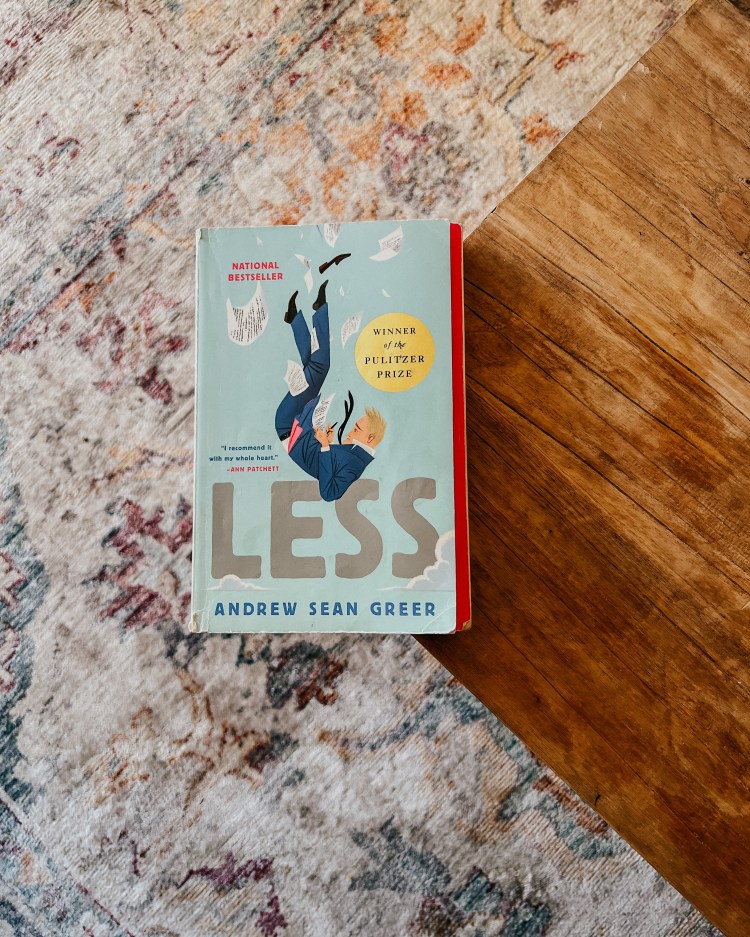
Publisher: Back Bay Books; Year Published: 2017
LESS is a book I’ve seen littered all over the bookish corners of the internet, in every used bookstore, on “notable book” stands in Barnes & Noble and other bookstores. It’s highly recommended. It’s won many literary awards, perhaps most notably it won the Pulitzer for fiction in 2018. When a book is hyped by everyday readers just as ferociously as it is praised by critics, I often feel immense pressure to like it. Then, in an attempt to be a contrarian, I feel the urge to hate it just because I can and it’d be a different take. But, good books are often just good and there’s very little room for criticism because the writing and the characters are such that to dislike it would be a sin. I found my copy of LESS on a bookshelf in my apartment building’s laundry room for discarded books (it’s a very passive book exchange within the building; a very sad Little Free Library of sorts). I picked the book up, put it in my To-Read pile, and forgot about it. Then Carley Thorne (Uncarley on Youtube) said it was one of her favorite books of all time and I thought, “well, ok, here we go…” and I picked it up.
It’s silly to pretend I wasn’t sure about it while reading those first few pages. But I was skeptical by the nature of knowing how esteemed this book is. I was hesitant because even people primed to dislike it recognized its brilliance (see Roxane Gay’s review on Goodreads). For one thing, this book is funny. Sometimes books that are about sad things try to be funny and it rings false or forced and I can’t really find the humor in what’s happening. This book, however, is often laugh-out-loud funny. It’s self-deprecating in an earnest way, making Less likable but also his own worst enemy. He is relatable even when nothing he’s doing or going through is something I’ve experienced firsthand. The writing is straightforward, with little frills but it begins to feel like a melody, a prayer, a repetitious tale that meanders and then punches you, probably mid-laugh.
MORE ABOUT THE BOOK
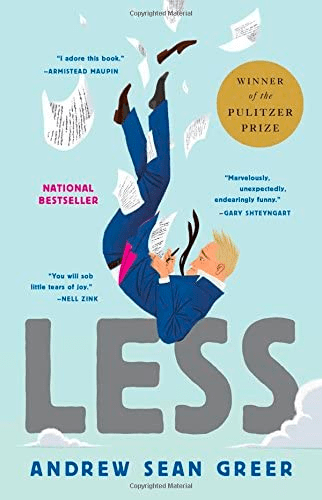
“PROBLEM:
You are a failed novelist about to turn fifty. A wedding invitation arrives in the mail: your boyfriend of the past nine years now engaged to someone else. You can’t say yes–it would all be too awkward–and you can’t say no–it would look like defeat. On your desk are a series of half-baked literary invitations you’ve received from around the world.
QUESTION: How do you arrange to skip town?
ANSWER: You accept them all.
If you are Arthur Less.
Thus begins an around-the-world-in-eighty-days fantasia that will take Arthur Less to Mexico, Italy, Germany, Morocco, India and Japan and put thousands of miles between him and the problems he refuses to face. What could possibly go wrong?
Well: Arthur will almost fall in love in Paris, almost fall to his death in Berlin, barely escape to a Moroccan ski chalet from a Sahara sandstorm, accidentally book himself as the (only) writer-in-residence at a Christian Retreat Center in Southern India, and arrive in Japan too late for the cherry blossoms. In between: science fiction fans, crazed academics, emergency rooms, starlets, doctors, exes and, on a desert island in the Arabian Sea, the last person on Earth he wants to see. Somewhere in there: he will turn fifty. The second phase of life, as he thinks of it, falling behind him like the second phase of a rocket. There will be his first love. And there will be his last.
A love story, a satire of the American abroad, a rumination on time and the human heart, by an author The New York Times has hailed as “inspired, lyrical,” “elegiac,” “ingenious,” as well as “too sappy by half,” Less shows a writer at the peak of his talents raising the curtain on our shared human comedy.”
The narration is excellent and is responsible for the third-act twist that I did not see coming. The narrator seems to have a candid perception of Arthur Less, but also a deep appreciation for him. For example, describing Less’s internal struggles, the narrator says, “The Garden of Bad Gays. Who knew there was such a thing? Here, all this time, Less thought he was merely a bad writer. A bad lover, a bad friend, a bad son. Apparently the condition is worse; he is bad at being himself.” While is a story of struggle, fear, and failure, it’s also a story of love, redemption, and hope. When I started reading, I wasn’t paying close attention, but slowly the story captured me more and more. My reading experience speaks to how the writing, which seems to not take itself too seriously, actually delves into issues and themes that are universal. The weight of it all sneaks up on the reader.
Have you read this one? If so, what’d you think?
 Read It Like Rory