
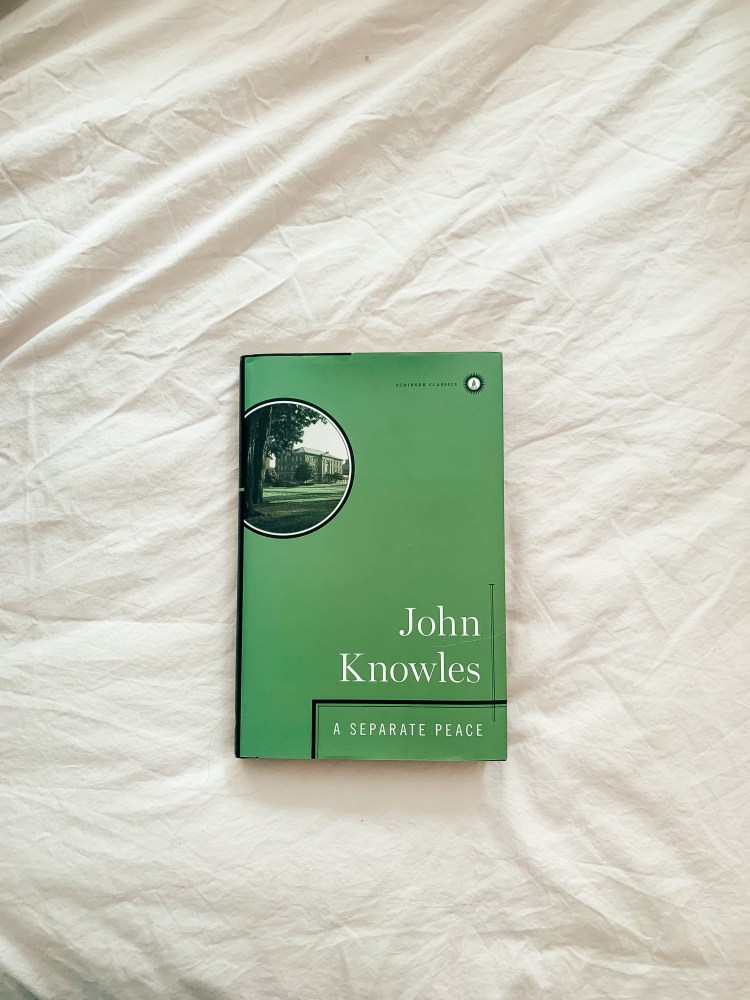
A Separate Peace is on nearly every high school reading list. I say nearly because it wasn’t on mine. When I was in high school, we learned classic books through a process called “extended readings,” which meant each student chose a book and presented on it. I think it would’ve been more efficient to assign the SparkNotes books, however, because at my small, rural California high school, I was one of few students who actually enjoyed literature and planned to pursue it in college. Alas, no one picked A Separate Peace and I never read it in college so it landed in the “lost pile” of books that I probably should’ve read but never did. Another list the book made? Banned Books. Another one? The Rory Gilmore Book List, which is the list that is ultimately responsible for me picking it up. I’m participating in the Rory Gilmore Book Club Challenge hosted by Jules of @bookish_jules, and for September the prompt was “a book set in a school.” Though it took me entirely too long to finally read A Separate Peace, I’m so glad I did. One of my favorite movies is Dead Poet’s Society and this gave me similar vibes.
Synopsis: “Set at a boys’ boarding school in New England during the early years of World War II, A Separate Peace is a harrowing and luminous parable of the dark side of adolescence. Gene is a lonely, introverted intellectual. Phineas is a handsome, taunting, daredevil athlete. What happens between the two friends one summer, like the war itself, banishes the innocence of these boys and their world.”
War books are always interesting of the twentieth century are always fascinating to me. War, as a general backdrop, often underlies male coming-of-age stories from the twentieth century and often serves as a foil to vulnerability and emotional reckonings. World War II exists almost entirely off-stage in this book, but is a constant threat to the idyllic campus of Devon, the men’s school where Phineas and Gene are roommates. In fact, acknowledgement of violence correlates with a loss of innocence. Interestingly, while war isn’t at the forefront of the novel and serves rather as a shadow over the events, the novel’s plot turns on an act of violence that leaves boisterous, uninhibited, and carefree Phineas crippled. Gene, increasingly jealous of Phineas, is behind the violence and its presented as a nearly subconscious decision, a fleeting moment where he makes a decision that ripples through the rest of the story. Phineas refuses to acknowledge or see it as a deliberate attack, insisting its an accident with a ferocity that insists innocence is at the root of everything. And so, as the war rages, Phineas refuses to confirm its existence, denying it is happening. And for Phineas, because of the violence that crippled him, he will not partake in the war, but rather will be left behind. However, the book ultimately begs the question: does the violence he endures protect him from the greater violence of war that will leave many men deceased or forever haunted by the horrors they witness?
The boys in the book, academics talking about athletics and grades, transform within its pages into men fearful of a global war that beckons them away from campus. Facing violence, facing something evil — this is the action that removes the tentacles of childhood and envelops the boys into adulthood. The aspects of life that caused angst and jealousy are eroded as a larger threat looms.
 Read It Like Rory