
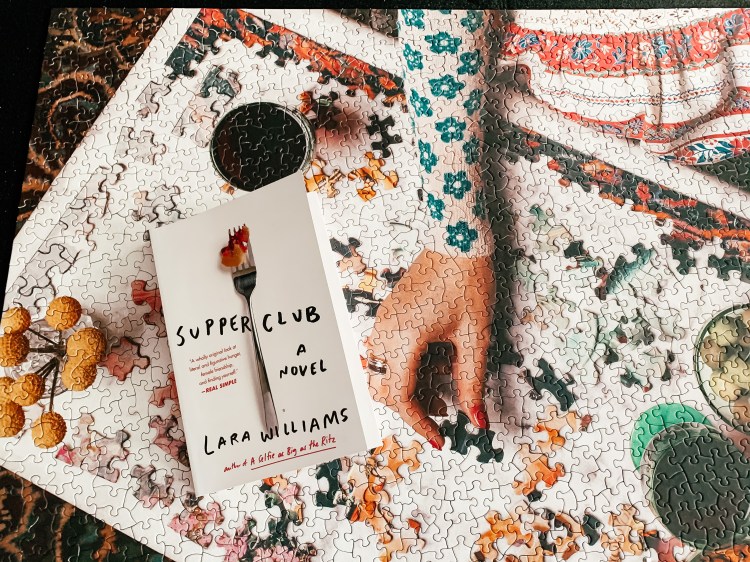
Publisher: G.P. Putnam’s Sons; Total Pages: 293; Year Published: 2019
Trigger Warnings: Disordered eating, sexual assault, emotional abuse, self-harm (cutting)
I saw Kally of @mycaffeinatedbookshelf recommend Supper Club for lovers of Sweetbitter by Stephanie Danler and I knew I had to read it. Then, when I found it in the bookstore, the back cover said it was for fans of, not only Sweetbitter, but also Donna Tartt’s The Secret History. If that is not the most on-brand book choice for me, I’m not sure what is.
Supper Club is a coming-of-age and sensual awakening for the book’s heroine, Roberta. Told in interspersed timelines, it explores her years at university and how her experiences there, and lack of some, inform her thirties, which is when we meet her. There is no delineation between Roberta’s college years and her thirties, which allows her character development to come through because the tone of the timelines is different. Roberta enters college a bright-eyed, eager academic excited for the possibility college holds: new beginnings, friendship, and men. When we meet her in her thirties, there is a performative aspect of her personality, like she sheds skins and camouflages herself—and her desires—to fit the mold she thinks her influences want her to fit. The mold, regardless of shape, often requires Roberta to be unnoticeable, to take up minimal space in any setting.
Enter Stevie, a free-spirited, feminist, independent artist who enjoyed living loudly and unconventionally. Roberta is at once enamored with and intimidated by Stevie. The unapologetic nature of Stevie’s existence is unknowable and intoxicating for Roberta as the two form a friendship—Roberta’s first female friendship that goes beyond the surface and gets into her fiber. In many ways, Stevie embodies everything that Roberta thought she would become when she entered the adult world and fled her hometown for university. Describing her hopes, Roberta says,
I thought leaving home would be a liberation. I thought university would be a dance party. I thought I would live in a room vined with fairy lights; hang arabesque tapestries up on the wall. I thought scattered beneath my bed would be a combination of Kafka, coffee grounds, and a lover’s old boxer shorts. I thought I would spend my evenings drinking cheap red wine and talking about the Middle East. I thought I on weekends we might go to Cassavetes marathons at the independent cinema. I thought I would know all the good Korean places in town. … And I thought I would be different. I thought it would be like coming home, circling back to my essential and inevitable self, I imagined myself more relaxed—less hung up on things. I thought I would find it easy to speak to strangers. I thought I would be funny, even, make people laugh with my warm, wry, and only slightly self-deprecating sense of humor. I thought I would develop the easy confidence of a head girl, the light patter of an artist. … I imagined others watching me, thinking, Wow, she is so free.“
p. 11
Roberta’s idea of herself during and after college never comes to fruition. She lives in a flat with five other people who never really see her, whether that’s because of her self-preserving erasure from the communal spaces or because of a dislike for her is unclear. Even when they eventually invite her to continue living with them in a new space, Roberta’s mode of acceptance is to promise that she won’t be in their way. One of the flatmates is annoyed and offended that Roberta refuses to be an active member of the living arrangement—an annoyance that will be mimicked later by Stevie, who criticizes Roberta’s passiveness. During college, Roberta discovers food and her capacity to enjoy it, specifically through cooking. Roberta finds a language in cooking that she can’t articulate in her everyday life. The descriptions of food are rich, luxurious, and whisper of a hunger to be satisfied. When Roberta meets Stevie, she meets the woman she always wanted to become but could never quite grasp. Upon meeting Stevie, Roberta begins trying to conform herself into a desirable friend (“The capacity of her gaze, i would soon learn, prompted me to amp up whatever I was telling her, to write checks I couldn’t cash.”). Eager to please Stevie, Roberta cooks for her and over wine and pasta, they discuss the men who can’t please them, the issues plaguing women, and the desire for more. More pasta, more partners, more pleasure. It is through their food that they derive the idea for the the Supper Club, a secret society built on violating conventions and bourgeois living.
To find their meals, they scour dumpsters for unused, still-ripe-for-the-picking food to turn into sumptuous meals that they can gorge to the point of being ill, that they can pair with copious amounts of wine and booze, they they can feast on before dancing freely in spaces not meant for them. The spaces that house the supper clubs are sometimes permissive — rented restaurants, but as things escalate, part of the sensuality of the club comes from entering a space without permission. This choice speaks to the novel’s larger intention for women to take up space in ways they are not conventionally seen doing.
The supper club itself is not as pervasive as I expected. This is, ultimately, a coming of age or coming to self story. The supper clubs, therefore, are meant to represent the characterization of Roberta. Each dish is carefully chosen to represent a tangible experience. For example, sourdough starters are described at length — a process of adding to and taking away dough, of molding and folding and reducing only to make larger again. Roberta, throughout the novel, is seen minimizing and maximizing parts of herself to contort her being to feed, literally and figuratively, the people in her life. Describing Kimchi, Roberta insists that the maker be patient because “The rot is still working its way through.” This comes after we’ve spent much of the novel being privy to Roberta’s unflinching self-criticism that eventually materializes as self-harm. At the novel’s close, we hear of a stew that ages like wine and is never truly finished. Food and it’s role in Roberta’s life is clear, but the delectable descriptions of food feel the epitome of double-entendre, always meant to convey something other than just a culinary tip. In this way, the entire premise of the club is a stand-in for women challenging expectation through overindulgence. I would’ve liked to see a bit more of the supper club, perhaps an exploration of each woman’s story or a deeper dive into the conversations, less than the acts, shared over the meals.
One thing that struck me in this story was the tension that forms between Stevie and Roberta. Roberta only wishes to please Stevie, which leads to inevitable disappointment because Roberta cannot live for herself when the goal is to make someone else happy. When Roberta finds someone she loves, after being raped in college and pursued by her lecturer who was many years her senior, but Stevie begins to issue the age old criticism of women who love but want to remain free: “You’ve changed since dating X.” The exploration of female friendship and how it morphs when one friend is in a relationship, particularly with a man, was nuanced and had echoes of criticism I’ve heard in my life.
I could go on. I barely touched on the men in this book, all of whom suck. I have some specific scenes I would LOVE to discuss, so if you read this or have already read it, please let me know!
 Read It Like Rory