
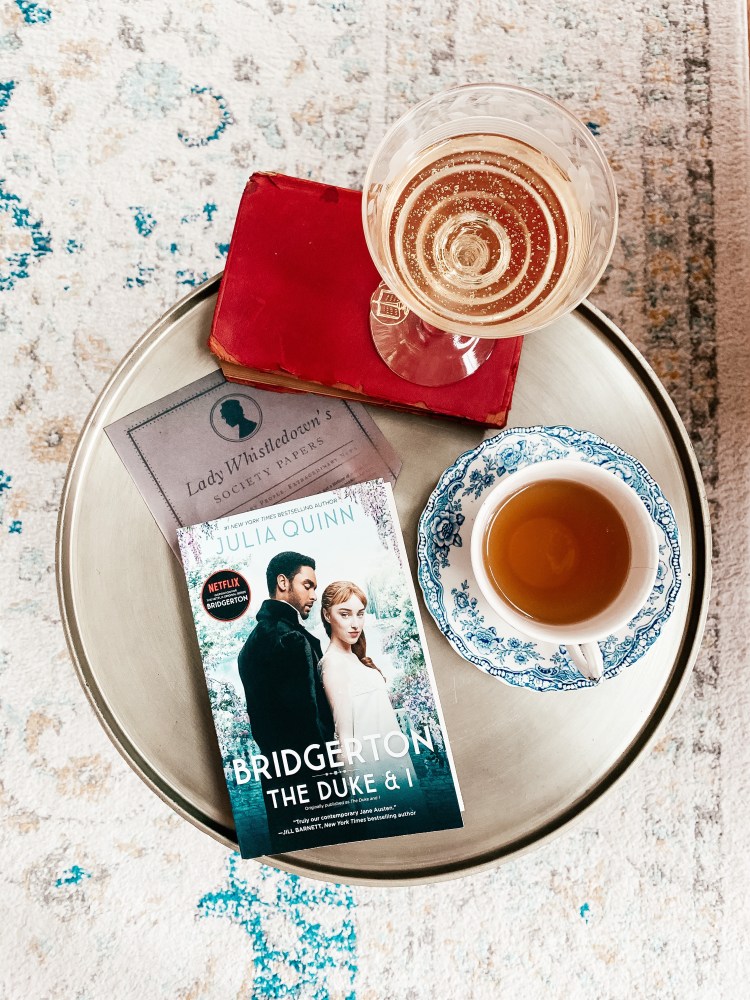
Publisher: Avon Books; Total Pages: 384; Year Published: 2000 (original publication year)
Trigger Warnings: child abuse; marital rape; sexual assault
I have a new obsession and it is certainly Regency England with a Gossip Girl twist. When I saw bookstagram raving about Bridgerton, Netflix’s adaption of The Duke & I by Julia Quinn, I decided to watch the show and then, upon loving it, decided to read the book. If you are unfamiliar with the story, below is the synopsis:
Synopsis: “In the ballrooms and drawing rooms of Regency London, rules abound. From their earliest days, children of aristocrats learn how to address an earl and curtsey before a prince—while other dictates of the ton are unspoken yet universally understood. A proper duke should be imperious and aloof. A young, marriageable lady should be amiable…but not too amiable.
Daphne Bridgerton has always failed at the latter. The fourth of eight siblings in her close-knit family, she has formed friendships with the most eligible young men in London. Everyone likes Daphne for her kindness and wit. But no one truly desires her. She is simply too deuced honest for that, too unwilling to play the romantic games that captivate gentlemen.
Amiability is not a characteristic shared by Simon Basset, Duke of Hastings. Recently returned to England from abroad, he intends to shun both marriage and society—just as his callous father shunned Simon throughout his painful childhood. Yet an encounter with his best friend’s sister offers another option. If Daphne agrees to a fake courtship, Simon can deter the mamas who parade their daughters before him. Daphne, meanwhile, will see her prospects and her reputation soar.
The plan works like a charm—at first. But amid the glittering, gossipy, cut-throat world of London’s elite, there is only one certainty: love ignores every rule…“
The Duke & I is the first in an eight-part series about the Bridgerton family. The introduction of the family, the descriptions of the time period and setting, the drama, the tension-building between Daphne and Simon, and the steam in this book were all amazing. I was all in and loving Daphne and Simon’s love story. I loved the banter between the two main characters and the family dynamics at play throughout the story. However, because I had already watched the show, I anticipated a scene that I worried would undo all the strong storytelling.
I appreciated that Simon and Daphne were communicative and open with each other because there was “no pressure” for them to follow the conventional courting rules. What confused me, and lost me, was that the communication flowed freely until it… didn’t. We spend so much of the book with characters talking about marriage and its importance and the fact that women must marry well, but any discussions around sex or intimacy are completely buttoned-up and lead to a naïveté in Daphne that’s hard to understand or accept. By the time Daphne marries, she doesn’t understand how procreation works. Initially, this seems like it may be a non-issue because Simon informs her he cannot have children, and Daphne’s lack of understanding of sex leads her to believe its a medical condition she is willing to accept in order to marry him. When Daphne discovers his inability is a question of semantics — he physically can have children, but will not — she is outraged and determined to bear children.
* SPOILERS AHEAD *
While watching the show, I read an article that discussed a problematic scene from the book and analyzed the show’s adaption of the scene. You can read the article here. I had various concerns about the scene in both the book and the show. After reading and watching, I felt the book scene was more horrific, but I didn’t think the show’s scene was much better in handling the confusion around Simon’s ability to have children. In the book, upon learning that Simon can physically have children, Daphne is upset but doesn’t act until later when Simon is intoxicated, and she assaults him while he’s barely conscious. The show’s Daphne’s action is much more premeditated as she decides to test her theory — enticing Simon to bed, where she takes control and doesn’t stop until the Simon is finished. The book’s Daphne has more remorse than the show’s Daphne, but neither reveal her to be the aggressor of an assault and both seem to heavily imply that Simon’s reliance on Daphne’s sexual ignorance was manipulative enough to mitigate or erase the trauma of Daphne’s assault. The show tempers the action, but it remains in the show, and show-runners doubled down on the decision to leave the scene, in some capacity, in the show as an important component of Daphne’s awakening.
The reason this scene in both the book and show is so harmful is it is unnecessary and relies on a toxic trope of historical romance. There are a plethora of other ways Daphne’s realization of Simon’s semantics could have been addresses, none of which result in a violation of Simon. For example, Daphne could have done what she did throughout the book — ask him to be honest. I envision a scene in which Daphne asks why Simon pulls out during sex. She could admit she doesn’t know how one becomes pregnant. They could have a heated, passionate argument in which they realize they have a major issue in their marriage, take time apart, and then Daphne could help Simon confront the trauma of his childhood and move passed it and then they mutually decide to go ahead with children. In the book, Daphne could’ve come to terms with the trauma Simon endured and help him through it rather than perpetuate more trauma. In the show this certainly would’ve tracked the storyline the show created without the necessity of the sex scene in which Daphne violates Simon. Neither the book nor the show handled the aftermath of the violation thoroughly (or at all really). In both, I rooted for Simon and Daphne, but I thought differently about Daphne than I had leading up to the scene. Bottom line: it was an unnecessary scene that made the book’s ending nearly impalpableble and the show’s ending uncomfortable. The show, for it’s part, seems to root its decision to include the scene as they did in Daphne’s sexual ignorance, implying she didn’t realize it was a violation and that makes it excusable.
*Spoilers End*
After reading the book and watching the show, I’d say watch the show, skip the book. I’ve read a lot of other reviews that say the rest of the series is excellent (like the first 85% of this book) and that consent is discussed explicitly and progressively. So, watch the show, then read books 2-8 and you will still get the full Bridgerton story.
 Read It Like Rory